Use all five supplied reference images as chronological visual keyframes for one uninterrupted construction timelapse. Interpret them as different stages of the exact same beachfront property in the following order:

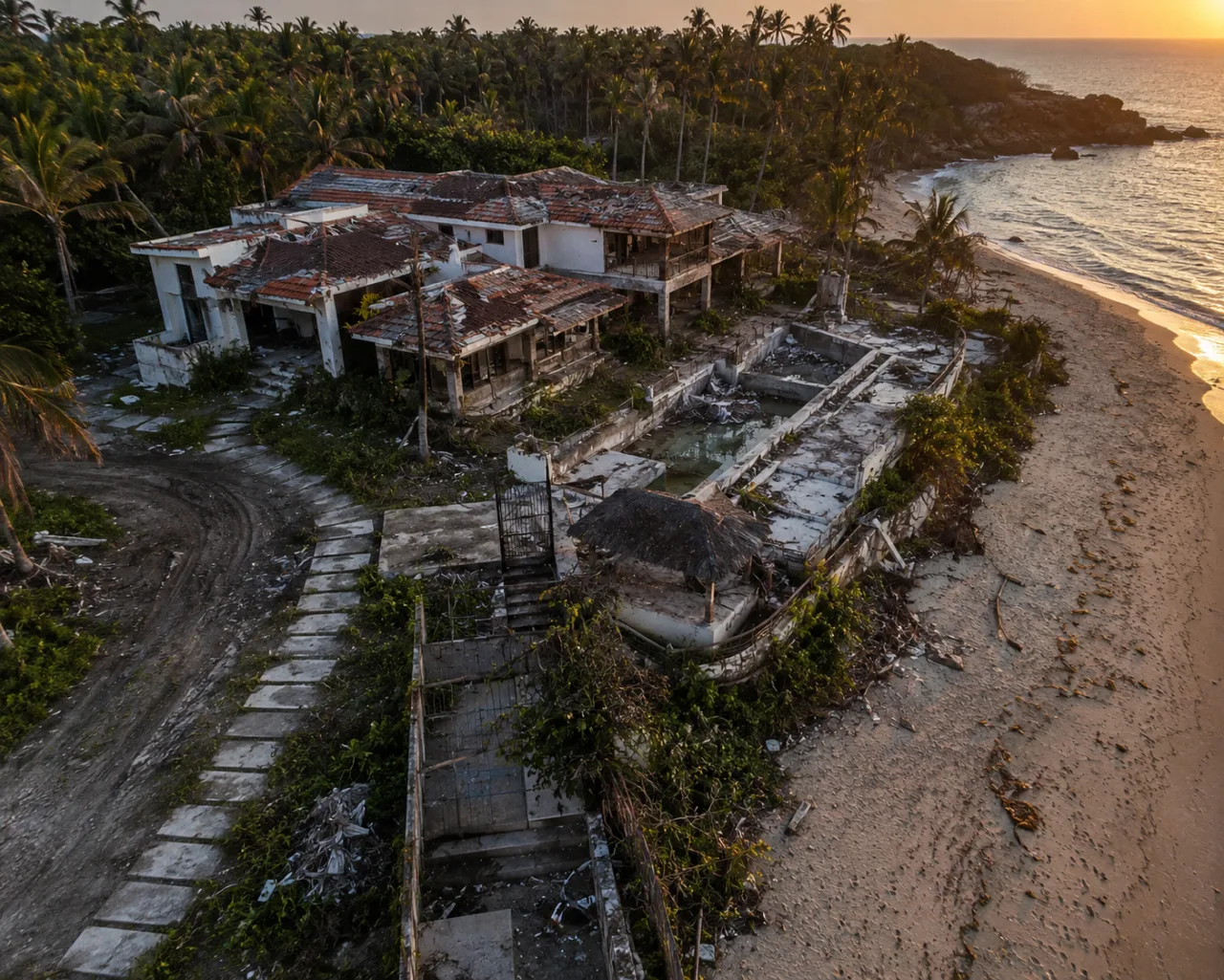
KEYFRAME 1: OPENING STATE:
The heavily ruined and abandoned beachfront villa with damaged red-tile roofs, broken walls, debris, vegetation, an empty deteriorated pool and neglected terraces.

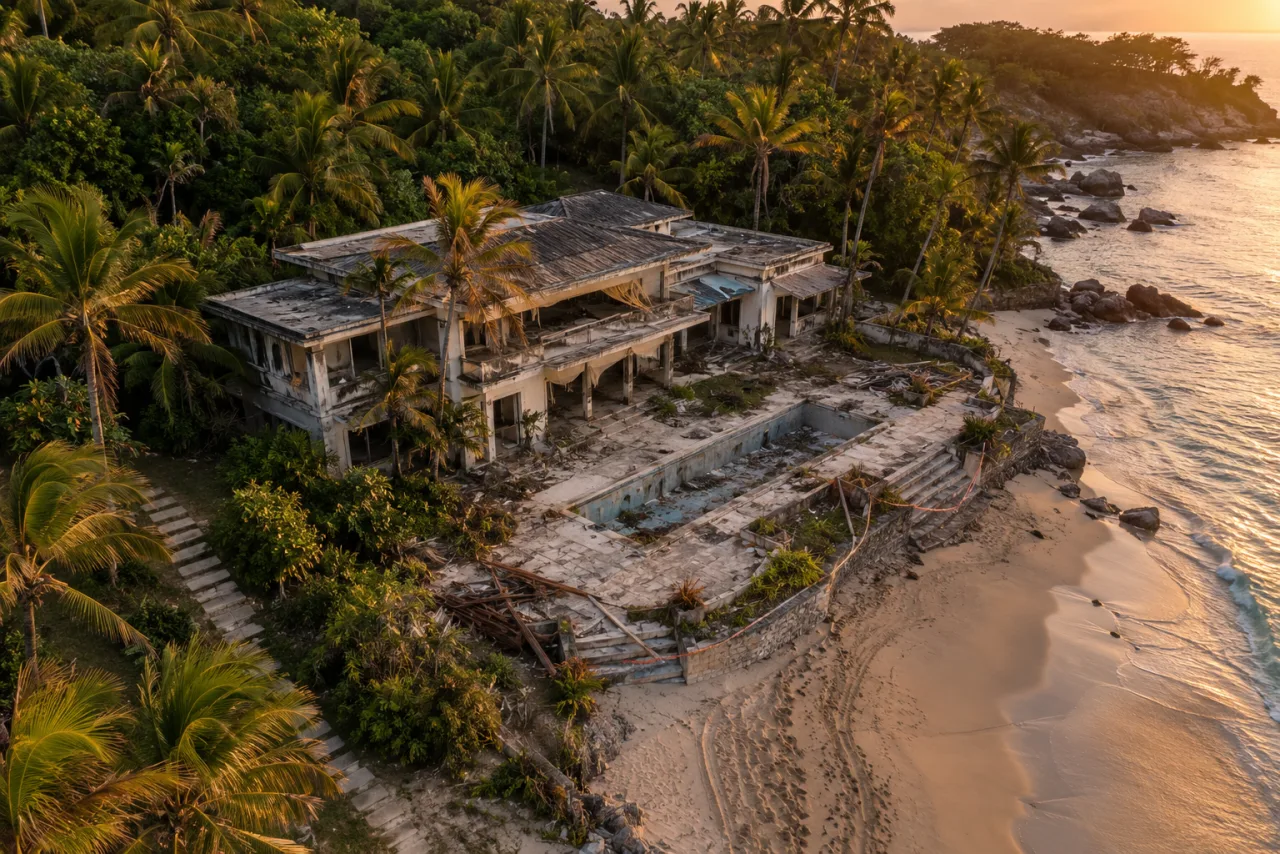
KEYFRAME 2: DEMOLITION AND SITE PREPARATION:
The stripped and partially demolished concrete property, with the old architecture progressively removed, the pool area cleared, vegetation cut back and the construction footprint prepared.

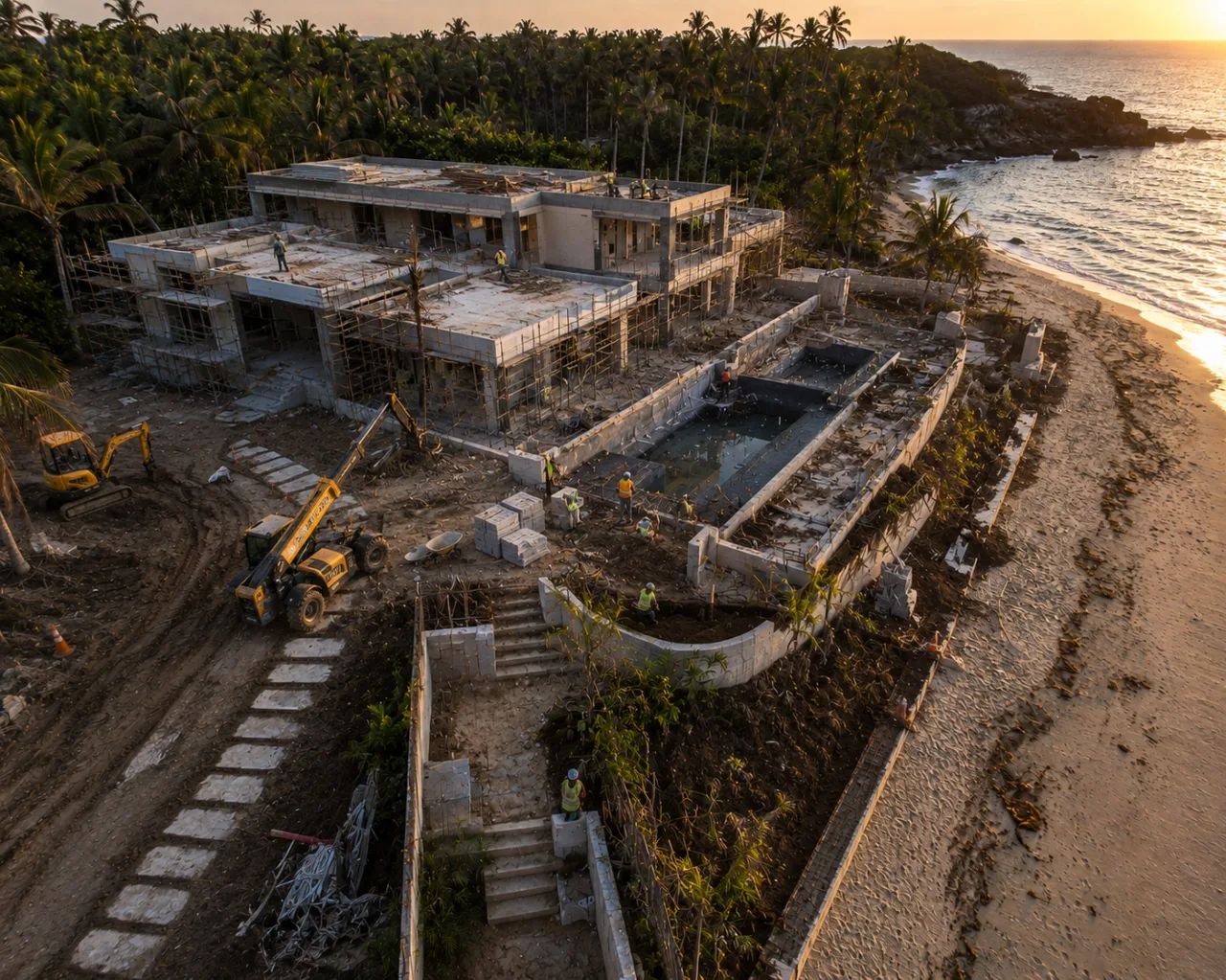
KEYFRAME 3: ACTIVE CONSTRUCTION:
The modern flat-roof beachfront mansion under construction, surrounded by scaffolding, workers, machinery, materials, unfinished concrete surfaces and the partially reconstructed pool.

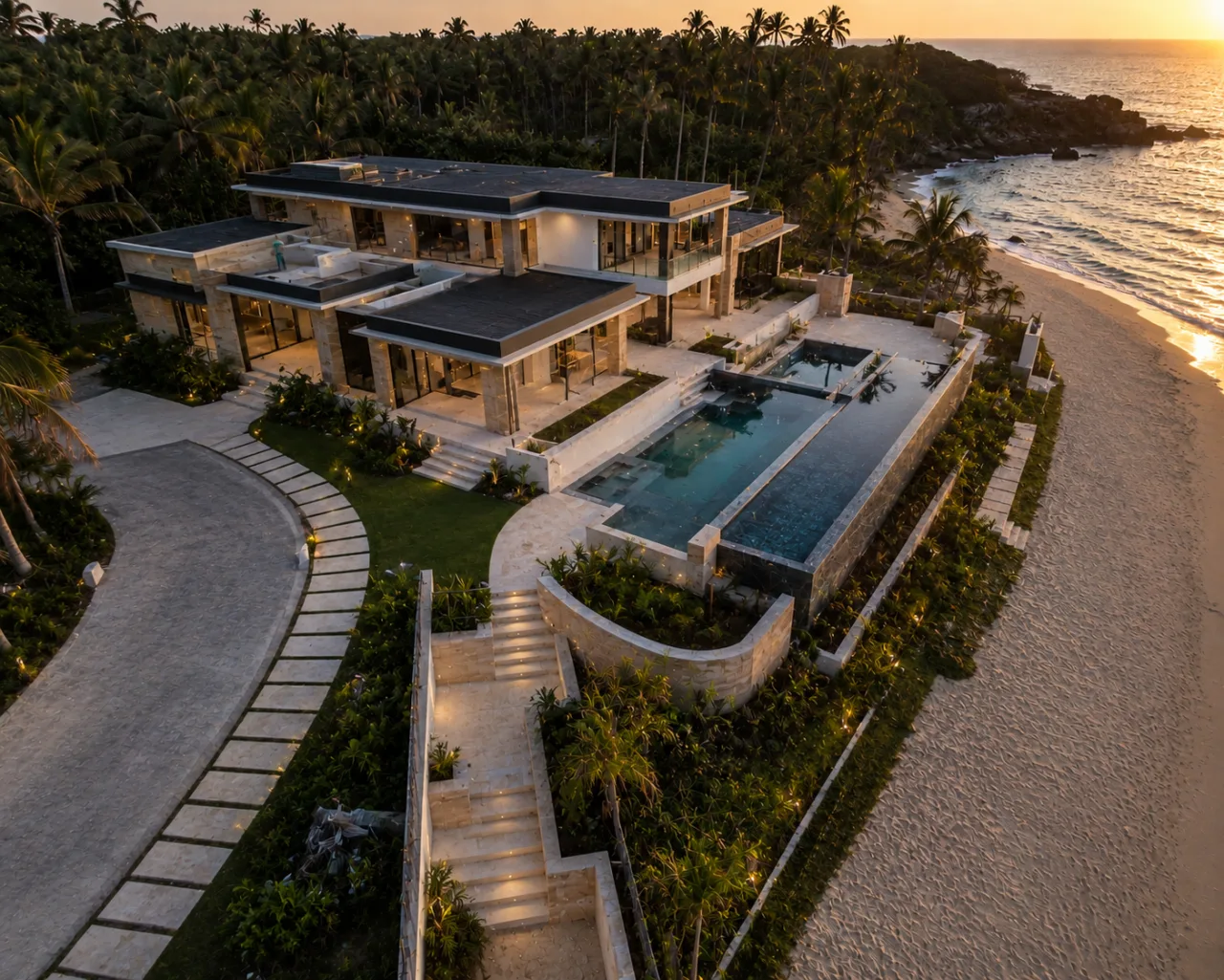
KEYFRAME 4: CLEAN ARCHITECTURAL COMPLETION:
The finished modern flat-roof villa with completed glazing, stone facades, terraces, pool, stairs and landscaping infrastructure, but still mostly unfurnished and not fully staged.

KEYFRAME 5: FINAL LUXURY REVEAL:
The fully completed, furnished and illuminated tropical beachfront mansion with glowing interiors, refined terraces, loungers, outdoor furniture, firepit lounge, mature landscaping, illuminated infinity pool and dramatic tropical sunset atmosphere.

The first four reference images define the primary camera position, architectural footprint, beach alignment and spatial geometry. The final luxury image is primarily a reference for finishing quality, furniture, landscaping, illumination, pool appearance, dramatic sunset color and premium editorial atmosphere. Do not abruptly reposition the camera to match a conflicting reference angle.

CAMERA AND SCENE LOCK:
Create one single continuous unbroken take with absolutely no cuts, transitions, dissolves, wipes, angle changes or hidden edits.

Lock the camera in world space at the same elevated high front-left aerial architectural viewpoint used by the construction and unfinished-completion references. Preserve a wide 24mm architectural lens feel, stable horizon, constant camera height, fixed focal perspective and consistent framing throughout the full transformation.

The following environmental landmarks must remain permanently locked in place:
- the curved sandy shoreline along the right side
- the rocky tropical cove in the upper-right distance
- the ocean horizon and sunset direction
- the stepping-stone access path in the lower-left
- the long pool zone running parallel to the beach
- the front stair and retaining-wall area
- the dense palm canopy behind the property
- the relationship between the villa, pool, terraces and shoreline

Do not move, rotate, resize or redesign the surrounding terrain. The ocean, beach, rocks, paths, palm forest and property boundaries remain spatially continuous throughout the entire video.

Only during the final hero-reveal section may the image perform an extremely slow and controlled digital crop push-in of approximately three to five percent toward the finished villa and infinity pool. This must not change perspective, horizon placement or architectural geometry. No physical drone flight, orbit or camera relocation.

OVERALL ACTION:
Show the entire property transforming from a severely ruined abandoned estate into a completely finished modern luxury beachfront mansion through a realistic accelerated construction timelapse.

Every change must be caused by visible human labor, tools, machinery, material handling, installation, cleaning or landscaping activity. Nothing may magically morph, teleport, assemble itself or appear instantly.

Do not directly morph the old red-tile architecture into the modern flat-roof architecture. The old structure must first be visibly dismantled, demolished and cleared by workers and machinery. The new modern villa must then be reconstructed progressively from the remaining foundation and prepared building footprint.

PHASE 1: SITE ARRIVAL, SAFETY AND PREPARATION:
Begin on the exact ruined property shown in the opening reference. Construction crews arrive through the access path. Workers wear realistic personal protective equipment. They unload fencing, cones, temporary lighting, toolboxes, wheelbarrows, cables and demolition equipment. Workers install safety barriers and construction fencing. Overgrown vegetation is trimmed manually. Loose timber, broken tiles, damaged furniture, metal, glass, concrete fragments and organic debris are sorted into separate piles and removed. No debris disappears between frames.

PHASE 2: CONTROLLED DEMOLITION:
Workers dismantle unstable roofs, damaged balconies, broken walls and remaining facade elements in a realistic sequence. Old roof tiles are removed before roof framing. Small excavators and demolition tools remove compromised masonry. Dust appears locally around active demolition zones and settles naturally. The demolition must look controlled rather than explosive. The original ruined villa is progressively reduced to a safe structural shell and prepared foundation. The pool is drained, cleared and partially excavated.

PHASE 3: EXCAVATION, GRADING AND FOUNDATIONS:
After demolition debris is removed, crews grade the site and prepare the new architectural footprint. Workers mark layout lines and elevations. Excavators dig foundation trenches and reshape the pool structure. Formwork is assembled piece by piece. Reinforcement steel is carried, positioned and tied. Concrete is delivered and poured progressively. Concrete surfaces cure gradually rather than instantly becoming finished architecture.

PHASE 4: STRUCTURAL CONSTRUCTION:
Columns, beams, floor slabs and retaining walls rise in a believable structural order. Scaffolding is assembled section by section by visible workers. Telehandlers transport pallets and building components. The ground floor structure develops first, followed by upper-floor sections, terraces, roof slabs and cantilevered elements. The long pool remains parallel to the beach. Do not generate instant complete floors; each component emerges through repeated worker activity.

PHASE 5: BUILDING ENVELOPE AND ROOF:
Workers install roof membranes, drainage elements, insulation, parapets and dark flat-roof finishes. Exterior walls are completed and rendered. Stone facade panels and stone-clad columns are installed individually. Large floor-to-ceiling glass panels arrive on glazing equipment and are carefully lifted, aligned and fixed by teams of workers. Do not allow glass walls or roof planes to appear in a single frame.

PHASE 6: POOL, TERRACES AND TECHNICAL FINISHES:
The infinity-pool shell is repaired, waterproofed, tested and tiled in realistic stages. Workers complete steps, spa sections, overflow channels and the long beach-facing infinity edge. Terraces and stairs are paved progressively. Recessed lights and path lighting are installed. The pool fills gradually through hoses and circulation systems and must not become instantly full. Once filled, the pool develops subtle turquoise reflections and illuminated underwater lighting.

PHASE 7: LANDSCAPING:
Workers form garden beds, deliver soil, install irrigation and plant tropical vegetation. Palm trees, shrubs, grasses and lawn sections are transported and planted through visible human activity. Plants do not grow magically from empty soil. Workers align stepping stones and finish the curved landscape edges. The surrounding existing palm forest remains stable throughout.

PHASE 8: CLEAN UNFURNISHED COMPLETION:
Scaffolding is dismantled section by section. Construction materials, temporary fencing, cables and machinery are removed through visible worker action. Cleaning crews wash glass, sweep terraces, pressure-clean stone surfaces and remove dust. The property becomes clean and finished, but remains initially sparse and mostly unfurnished.

PHASE 9: HUMAN-DRIVEN LUXURY STAGING:
Staging crews arrive with outdoor furniture, loungers, sofas, side tables, cushions, planters, accessories, firepit components and decorative objects. Every object must be physically carried into the scene by people, who lift, rotate, assemble, align and adjust each item. Pool loungers are placed individually. The firepit lounge near the lower-left side of the pool is prepared manually. Do not allow any furniture, cushions, lights, decor or plants to appear without visible human handling.

PHASE 10: LIGHTING AND FINAL REVEAL:
As the workers finish, warm interior lights switch on gradually room by room rather than all at once. Exterior architectural lighting, garden lights, path lights, pool lights and firepit glow activate sequentially. The remaining workers collect tools and leave the property through the access path. Transition naturally into the fully staged luxury state represented by the final reference image while maintaining the camera geometry established by the construction frames.

FINAL HERO MOMENT:
During the final section, human construction activity stops completely. Perform only a very subtle controlled digital push-in toward the villa and infinity pool. Keep the horizon, shoreline, cove, palm canopy and architectural perspective stable. The sunset becomes slightly richer without changing the direction of light. Warm orange, gold, coral and pink tones illuminate the clouds and reflect subtly across the ocean and glass facade. Show gentle pool ripples, small waves reaching the beach, subtle palm-frond movement and delicate firepit flames. The villa remains physically static and no people remain visible during the final polished luxury-estate hero reveal.

TIMELAPSE MOTION:
Use coherent accelerated timelapse pacing with natural motion blur on workers, machinery and repeated manual activity. Permanent architecture, terrain and fixed landmarks must remain sharp and stable. Sunset illumination may shift gradually, but avoid sudden day-night changes, flashing exposure or inconsistent shadow direction. The complete transformation must feel like months of demolition, construction, finishing, landscaping and staging compressed into one continuous cinematic shot.

VISUAL QUALITY:
Ultra-photorealistic premium architectural cinematography, realistic construction processes, believable material physics, accurate human scale, high-detail stone, concrete, glass, metal, wood, vegetation, water and sand, refined luxury real-estate commercial quality, stable temporal consistency, natural HDR, realistic reflections and physically plausible lighting.

STRICT NEGATIVE CONSTRAINTS:
No cuts. No transitions. No dissolves. No wipes. No camera orbit. No drone movement. No camera drift. No camera shake. No perspective jumps. No sudden reframing. No changing lens. No horizon movement. No geometry warping. No architectural melting. No direct morphing between the old and new villa. No instant demolition. No instant construction. No reversed construction. No disappearing debris. No teleporting workers, machinery or materials. No floating tools or furniture. No self-assembling structures. No materials moving without human or machine contact. No complete floors appearing instantly. No completed villa appearing in one step. No furniture appearing instantly. No magical plant growth. No machines intersecting structures. No workers walking through objects. No duplicate, giant or miniature people. No distorted bodies or extra limbs. No changing beach shape. No moving rocks. No changing property boundaries. No shifting palm forest. No pool changing position or dimensions. No ocean flooding the construction site. No flickering glass. No changing architecture after completion. No flashing lights. No exposure pumping. No sudden weather changes. No text. No captions. No readable signs. No brand logos. No watermarks.
 01 Ruine
 02 Abriss
 03 Rohbau
 04 Fertig
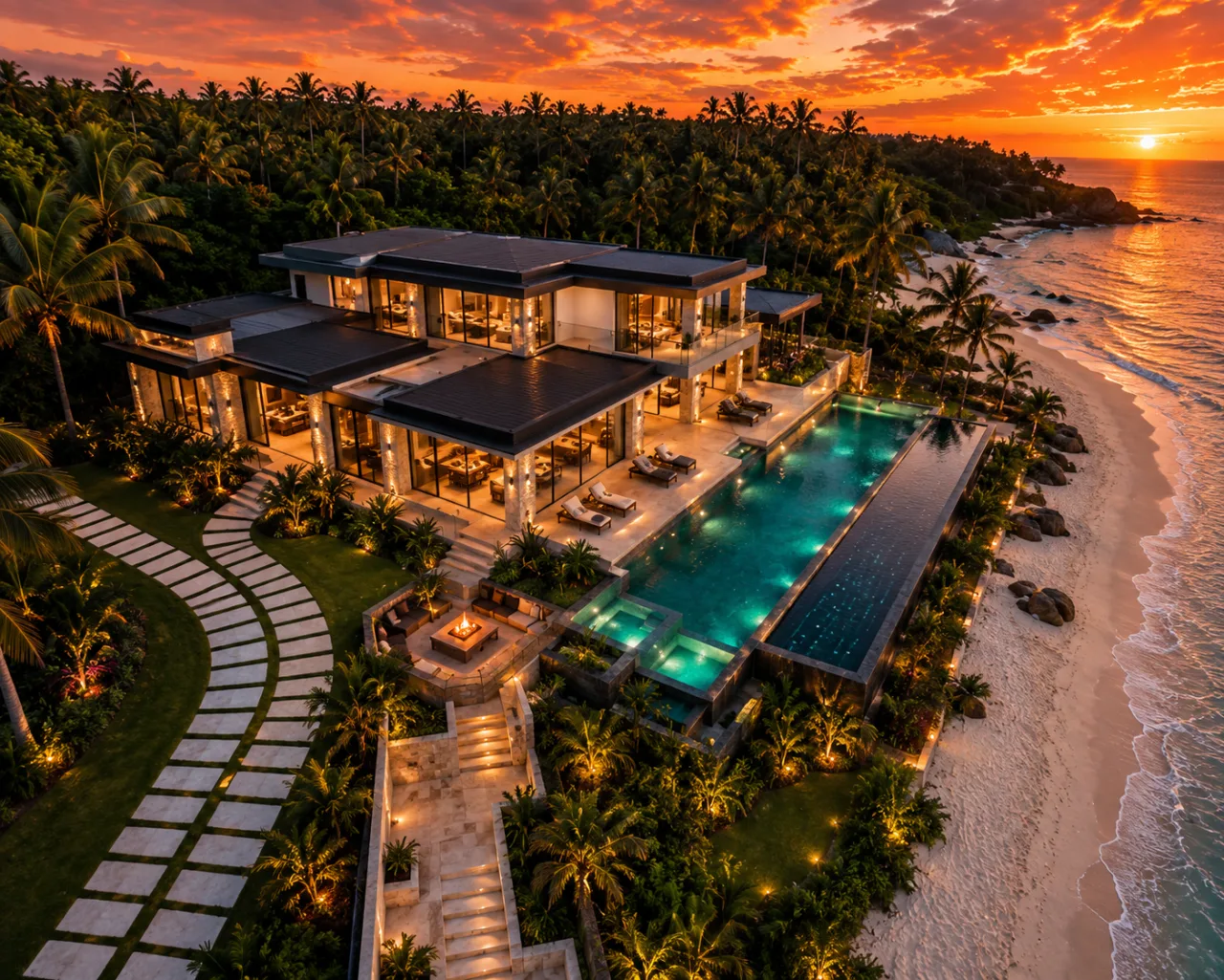 05 Luxus